There are no items in your cart
Add More
Add More
| Item Details | Price | ||
|---|---|---|---|
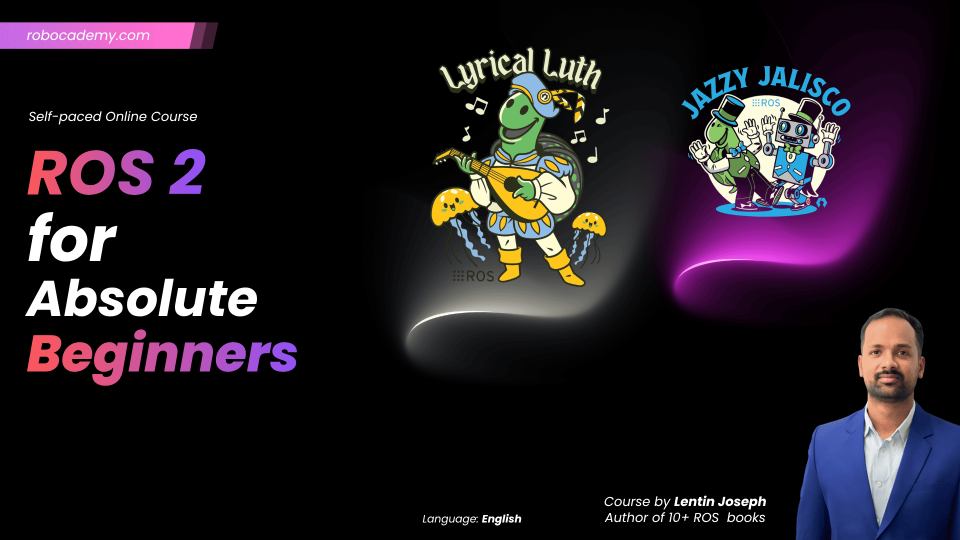
Learn ROS 2 from scratch using hands-on exercises, Python, C++, Turtlesim, and a practical mini-project based on the latest ROS 2 Jazzy and Lyrical distributions.
ROS 2 is the industry-standard robotics middleware powering modern robotic systems across industries, research institutions, and autonomous technologies.
Used for navigation, localization, mapping, and autonomous decision-making.
Used in manufacturing, automation, and smart factory environments.
Powering robots used in healthcare, retail, hospitality, and logistics.
Widely adopted in self-driving vehicles and transportation systems.
Build intelligent aerial systems for perception and navigation.
The preferred robotics framework for research and education.
This course is designed for anyone who wants to learn ROS 2 and robotics software development from the ground up. Whether you are a student, software engineer, researcher, hobbyist, or a professional transitioning into robotics, this course provides a structured path to build practical ROS 2 skills.
No prior ROS or robotics experience is required. Start from the fundamentals and build your skills step by step.
Gain practical ROS 2 skills that complement your academic studies and robotics projects.
Transition into robotics software development by learning ROS 2, Python, and C++.
Understand how ROS 2 integrates with sensors, embedded hardware, and robotics platforms.
Combine software, electronics, and mechanical systems knowledge through practical ROS 2 development.
Learn the ROS 2 ecosystem widely used in robotics research and autonomous systems development.
Turn your passion for robotics into practical skills by building real ROS 2 applications and projects.
Acquire the foundational ROS 2 skills required to begin a career in robotics software engineering.
This course is carefully designed to provide a practical, beginner-friendly, and industry-oriented learning experience in ROS 2.
Designed for learners with little or no prior ROS 2 experience.
Follow a structured roadmap from fundamentals to practical projects.
Learn ROS 2 using the latest ROS 2 distribution.
Gain experience with the Long-Term Support ROS 2 release.
Learn ROS 2 development using both major programming languages.
Explore ROS 2 development using containerized environments.
Follow the course on Windows, Linux, or macOS using VirtualBox.
Compatible with Ubuntu 22.04, 24.04, and 26.04 environments.
Reinforce concepts through practical ROS 2 exercises.
Apply your knowledge by building a complete ROS 2 application.
Access source code and resources used throughout the course.
Learn development practices used in professional robotics teams.
Learn techniques for identifying and resolving ROS 2 issues.
Revisit the course materials anytime and learn at your own pace.
The goal of this course is to provide a strong foundation in ROS 2 and robotics software engineering, enabling you to confidently develop ROS 2 applications and understand the core concepts used in modern robotics systems.
Upon completion, you will be well-prepared to continue your learning journey into advanced topics such as simulation, navigation, SLAM, autonomous systems, and real-world robotics development.
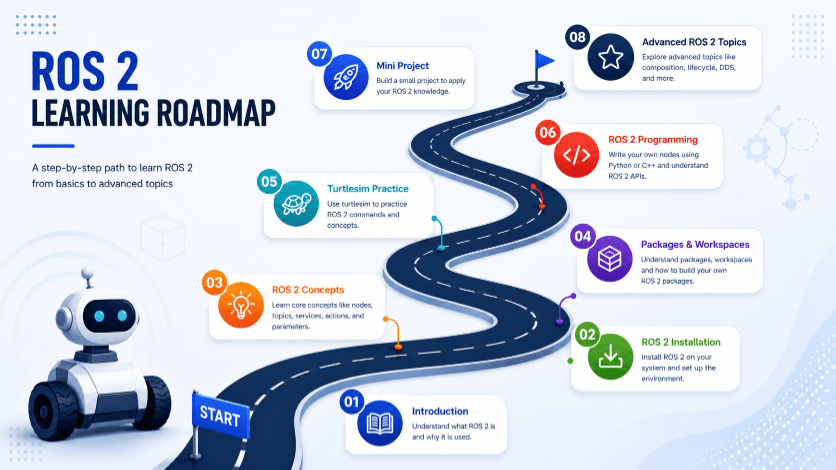
Learn what ROS 2 is, why it is the industry standard for robotics, and how it powers modern robotic systems.
Install ROS 2 Jazzy and Lyrical, configure your environment, and prepare a professional development workspace.
Master the core ROS 2 communication mechanisms including Nodes, Topics, Services, Actions, and Parameters.
Create, organize, build, and maintain ROS 2 packages and workspaces using industry best practices.
Reinforce ROS 2 concepts through practical exercises using Turtlesim and ROS 2 command-line tools.
Build real ROS 2 applications using Python (rclpy) and C++ (rclcpp) through guided examples.
Learn professional debugging techniques, troubleshooting methods, and robotics software engineering practices.
Apply everything you've learned to develop a complete ROS 2 application from scratch.
This course is designed for beginners and requires no prior experience with ROS or robotics. The following prerequisites will help you get the most out of the course.
Recommended:
Throughout this course, we will use a set of industry-standard tools and technologies commonly used in robotics software development. These tools will help you learn ROS 2 development, package management, programming, virtualization, and version control in a practical and hands-on manner.
The primary operating system used throughout the course for ROS 2 development and practical exercises.
Learn ROS 2 using the latest and long-term support distributions, covering essential robotics concepts and development workflows.
Develop ROS 2 applications using both Python (rclpy) and C++ (rclcpp), the two primary ROS 2 programming languages.
Create a consistent Ubuntu-based development environment regardless of whether you use Windows, Linux, or macOS.
Learn how ROS 2 applications can be containerized and deployed using modern Docker workflows.
Manage source code, track changes, and collaborate effectively using the industry-standard version control system.
A powerful and lightweight code editor that can be used for ROS 2 development and debugging.
Practice ROS 2 concepts through hands-on exercises using one of the most popular beginner-friendly ROS applications.
These tools are widely used in robotics research, education, and industry, providing a solid foundation for further learning and professional development in robotics and autonomous systems.
Learning ROS 2 opens doors to exciting career opportunities in robotics, autonomous systems, AI, and industrial automation.
Design, develop, test, and deploy software systems for robots and autonomous platforms.
Build intelligent systems capable of perception, planning, and autonomous decision-making.
Combine artificial intelligence and robotics to create intelligent autonomous machines.
Develop next-generation automation solutions for manufacturing and smart factories.
Contribute to cutting-edge robotics innovations in academia and industry.
Create innovative robotics products from concept to deployment using ROS 2 technologies.
By the end of this course, you will have developed the practical skills needed to build, debug, and maintain professional ROS 2 applications and robotics software systems.
Build a strong foundation in ROS 2 concepts and workflows.
Learn modern software development practices for robotics.
Gain confidence working in Linux development environments.
Master Topics, Services, Actions, and Parameters.
Develop ROS 2 applications using Python and rclpy.
Build high-performance ROS 2 applications with C++.
Create and manage ROS 2 packages effectively.
Organize and maintain ROS 2 workspaces efficiently.
Inspect, debug, and manage ROS 2 applications.
Diagnose and resolve common ROS 2 issues.
Build complete ROS 2 robotics applications.
Apply professional workflows and best practices to robotics projects.
1. Who can join this course?
This courseis designed for absolute beginners. Students, freshers, working professionals, and anyone interested in Robotics & AI can join. No prior robotics or AI experience is required.
2. Can I follow this course on Windows, Linux, or macOS?
Yes. The course uses VirtualBox with an Ubuntu virtual machine as the primary development environment. This allows you to follow the course regardless of whether you use Windows, Linux, or macOS, while ensuring a consistent learning experience for all students.
3. What will I be able to do after completing this course?
After completing this course, you will have a strong foundation in ROS 2 and robotics software development. You will be able to create ROS 2 workspaces and packages, develop applications using Python and C++, work with topics, services, actions, and parameters, and build your own ROS 2 projects. You will also be well-prepared to move on to advanced topics such as Gazebo, RViz, Navigation2, SLAM, and real robot development.
4. What computer specifications do I need for this course?
A computer with at least 8 GB of RAM, an Intel Core i5 (or equivalent) processor, and 40 GB of free disk space is recommended. If you plan to run Ubuntu inside VirtualBox, 16 GB of RAM will provide a smoother experience. A dedicated GPU is not required.
5. Will I receive the source code and course resources?
Yes. The course includes downloadable source code, example projects, exercises, and other learning resources. You can use these materials to follow along with the lectures and practice the concepts covered in the course.
6. Will I receive a certificate upon completing the course?
Yes. Upon successfully completing the course, you will receive a Course Completion Certificate from Robocademy. This certificate demonstrates your understanding of ROS 2 fundamentals and can be shared on your resume, LinkedIn profile, and professional portfolio to showcase your robotics software development skills.
8. What kind of support will I receive during the course?
Students enrolled in the course will have access to a dedicated course discussion and support channel within the Robocademy platform. You can ask questions, share issues, discuss concepts with fellow learners, and receive guidance from the instructor and support team. We encourage students to include screenshots, code snippets, and error logs when seeking help to ensure faster and more effective assistance.
 Launch your Graphy